Monday, June 18, 2012

Travel: Egypt


http://www.scotsman.com/scotland-on-sunday/scotland/travel-egypt-1-2360429
Published on Sunday 17 June 2012 20:12
EGYPT doesn’t disappoint with its stunning architecture, history and sights – and that’s before the heatstroke and delirium kick in
The tour guide has slumped to a resting stop in the shade, reclining in a street café somewhere up ahead, gathering himself and trying to find the inch of seat that isn't to his backside what hot sand is to the soles of a lizard. I'm not surprised. It's 8pm and we've been walking all day in 42-degree heat. We're goosed.
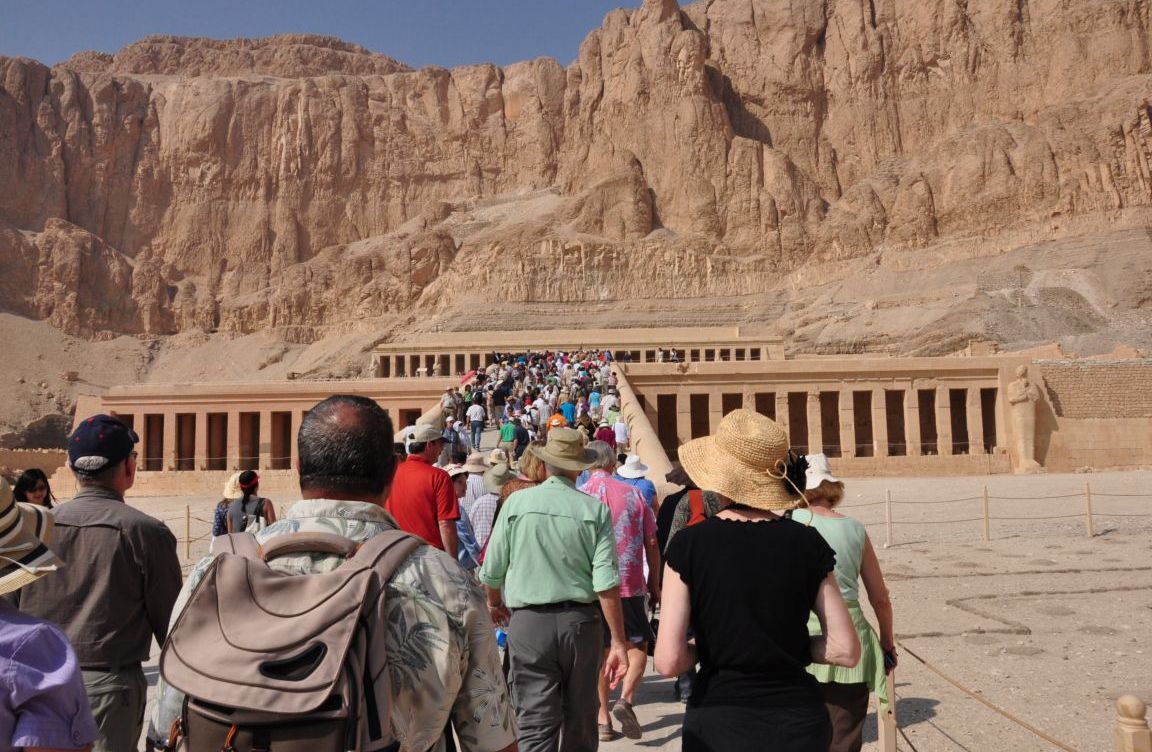
The greatest female pharaoh of them all, Queen Hatshepsut (1458 BC) had to have her shade on a vast scale, be it a chapel or temple amid the hundreds of awesome buildings still standing from her reign. Those kings down Luxor way knew a good few months digging into the hillside could do wonders for your air conditioning if you persevered too. But I and 20 or so other tourists are peching our way round a nine-day Egyptian tour crammed tighter than Tutankhamun's tomb with sights, so a chance to stop off in the shade and sip a little hibiscus tea as the locals gather at Khan El Khalili market mosque for the fourth salah (prayer) of the day is most welcome.
Tahrir Square
For Egypt is epic. Don't let anyone who has “grabbed a last-minute cheapie to Sharm El Sheikh, never left the sun lounger" tell you otherwise. It is epic in its geology, its history and, for a westerner, certainly, its assault on the senses, from the swirl of Cairo's Tahrir Square to desolate stretches of land as the Nile takes you south to the Valley of the Kings.

We land in Cairo late at night, so awaken to the sounds and speeds of the city. The felucca boats are out on a Nile so thick with grime they're steering through caramel. We're headed for the now famous Tahrir Square, a city centre construction with squares off squares and roundabouts off roundabouts and all the horn-tooting and pedestrian confusion that goes with a city of 16m people and counting. All roads, however, lead the eye to Cairo's crowning glory, the Egyptian Museum, the museum of antiquities – notoriously looted during the Arab Spring of 2011. And who could not be thrilled at the Indiana Jones adventure made true as you stare Tutankhamun's death mask in the face or wander round the mummified pharaohs, just some of the restored museum’s treasures? It's the stuff of childhood dreams.Truth be told, however, I am relieved to get away from the dirt and darting eyes of the city and break out into the country on an overnight train to Aswan. It is more Darjeeling Limited than Orient Express, but adds to the adventure of seeing the vast desert of Egypt via its lush spine, the Nile. The rickety train's journey in and out of country stations gives a view of Egyptians in their domesticity and, had it not been clear from Cairo's suburbs, it certainly is here, that striking poverty runs to the core of Egypt's troubles as deeply as the river itself.
Aswan is a desert city, but its monumental High Dam (think opening scene of GoldenEye) backs up the Nile to form the world's largest reservoir, the 500km-long Lake Nasser. In temperatures too hot even for louping lizards, the sight of a vast water supply brings on hallucinatory glee as we stroll along it in full knowledge that aquatic surroundings can not be far.
Our guide, however, teases us with a trip to Aswan's Temple of Philae, dedicated to the goddess Isis. Some of the fascinating carvings in the interior of the temple still retain their rich colours, such was the sophistication of the early Egyptians’ craft for visual storytelling and the dry climate's wondrous preservation. Isis is depicted as the ideal mother symbol, not least when she is presented as the mother of Horus, god of war, and one of the most celebrated gods of Egyptian history. Not a bad lad to have brought into the world.
With that sail around Egyptian mythology and family values, we are escorted on to our boat for the ultimate in Egyptian sightseeing, a three-night cruise up the Nile to the spectacular Valley of the Kings in Luxor. It is here that the temptation to start aligning your fellow tripsters with Agatha Christie's Death on the Nile characters proves too much. Among the youngest in the party, we have great fun imagining the lives, loves and misdemeanours of everyone as they parade round the boat-top pool by day and the buffet table by night.


The aforementioned Valley of the Kings and the Temple of the Queen Hatshepsut are our destination. The Valley sits across the Nile from Luxor (formerly Thebes) and was the burial ground of Egypt's nobles for over 500 years. With little visible from the road other than magnificent limestone mountains, on closer inspection the Valley is an utterly discombobulating experience. Carved into the mountains are over 60 tombs, most of which have numerous chambers.
It was here that Tutankhamun's tomb was discovered, and around these hills are the chambers of generations of Rameses. Hatshepsut is here too, resting from her celebrated and peaceful reign. Descending the minute steps into these tombs can be perilous, but the pay-off is an insight into the carvings and scripts worshipped as narratives of faith and decorative enablers into an afterlife by the pharaohs. In the cool, low light the air is still and sacred. Exiting is as dazzling an experience, as the searing sun and lack of any modern reference for miles disorientates you in the living history of this place.
Venturing back to Cairo via the Red Sea Riviera resort of the Hilton Hurghada, it's clear the unchanged nature of Egypt's great architecture and landscape is exactly what makes exploring it such a mindblowing experience. Not just to stand beside, but to touch the only remaining Ancient Wonder of the World, the Great Pyramid of Giza, completed in 2560BC, is to shake your certainties of time, history, faith and civilisation to their core. We've established that 42 degrees with no shade delirium may have kicked in a while back, but these experiences cannot be underestimated.
The pyramids are fascinating in their juxtaposition against the city of Cairo, with its ongoing surge for revolution fuelled by entrenched disparities between classes and the sexes. My impression is that a woman in Cairo is made aware of her minority and rarely in the most subtle of manners by the packs of men passing hours in the streets, with barely a female Egyptian visible in public life. Dynasties have passed since Queen Hatshepsut's awe-inspiring reign, but so much of Egypt remains still in her wake.
The Travel Department (0131-516 3885, www.thetraveldepartment.co.uk) runs escorted holidays to Egypt from Edinburgh and Glasgow to Cairo with British Airways (via London Heathrow) from £1,099 return for nine nights. Bookings are now being taken for trips starting on 26 September. Included in the deal is luxury coach transfers, excursions, meals, three nights’ accommodation in four-star hotels the Shepheard and the Oasis, Cairo, two nights at the Hilton Hurghada Resort, as well as a three-night, five-star Nile cruise.

Sunday, June 10, 2012

Pitt stop in Egypt: Brangelina's honeymoon


The Hollywood of the Middle East otherwise known as Egypt is set to receive two of Hollywood's most eminent luminaries - Brad Pittand Angelina Jolie. Combined they are double-hit Brangelina. So famous are they individually that their star appeal in a couple soars off the roof in its mega-cool factor. The ultra super-stars, both known for their sex appeal as fantasies for the opposite sex, will take their high profile honey moon following a winter marriage in Aswan and Al Aqsar, they have told Egyptian Minister of Tourism Munir Fakhri.

The film stars made a surprise visit to Egypt earlier, and finding themselves in awe of the beautiful historical landmarks of Al Aqsar, home to the temples of Phiae, the Nubian Museum and more, wanted to come back back for more.
The secret reconnaissance mission saw the Minister of Tourism make a trip to Cairo especially to accompany them to dinner overlooking the Nile.
The finally engaged couple, no strangers to the walk of fame will be walking the aisle after a seven-year relationship that has already borne three biological and three adopted kids.

Friday, June 1, 2012

Of tourism and aspiration

At Port Ghaleb, Ahmad Mahmoud wonders about the future of tourism


Since the Egyptian revolution 15 months ago, tourism has been struggling for survival. With news of strikes, clashes and the occasional abduction of tourists in Sinai, tour operators have cancelled significant portions of their business across Egypt. Now the Minister of Tourism, Mounir Fakhry Abdel-Nour, is trying to reverse the tide; and tremendous efforts are being made to tell the world that Egypt welcomes visitors and its people are the ones who guarantee their safety. Among the main challenges facing the tourism sector is the media, domestic and international, and how to reach a formula for the optimum understanding between the media and travel sectors. To this end the second UNWTO International Conference on Tourism and the Media, entitled "Partering with the Media in challenging Times", was held in the spectacular Port Ghaleb resort in Marsa Alam. The aim of the two-day conference (26-27 April) was to promote tourism as a driver of economic growth, inclusive of development and environmental sustainability, offering leadership and support in advancing knowledge and tourism policies worldwide.

Speaking to a huge audience in the conference's opening session, Egypt's minister of tourism said the government is adopting a new slogan for tourism, "I Am Egypt", aiming to highlight the role of the average citizen in promoting tourism. Egypt, he said, is trying to preserve natural resources, recycle refuse, train workers in the tourism business and improve the marketing of destinations. And, while Egypt's touristic attractions are not yet fully explored, Abdel Nour feels the country has everything going for it: the weather, the endless beaches, the unexplored desert as well as great potential for Nile cruises. Tourism is not just a matter of finance, development, and promotion. As the minister pointed out, there should also be a more equitable distribution of wealth in the Sinai and Upper Egypt. The locals may be allowed to own shares in tourist companies. If they are hired by the tourism sector, they will feel the immediate benefits of this activity.

Egypt seeks to encourage British tour operators to resume their activities in Egypt to their former level. The government is also eager to attract Chinese tourists. "The number of Chinese tourists worldwide has increased from 70 million last year to 84 million this year," he noted. Other target markets include tourists from Latin America, especially Brazil. But the number of tourists from Italy and Finland is returning to previous levels. "We have an awareness campaign targeting Egyptian citizens, to tell them how to deal with tourists and to point out how important tourism is for the country," Abdel Nour said. It cannot be hard to persuade Egyptians of the importance of tourism. With one out of seven families depending fully or partially on income from tourism, the value of tourism is not lost on the average Egyptian. Indeed, during the 25 January revolution, some protestors carried signs telling tourists to stay in the country and have no fear.

The government is currently making sure that local communities will become active stakeholders in the tourism business: "We have a pilot project in Dahshour to encourage traditional industries. It is a private sector project that aims to improve local skills, increase income, and maintain the fabric of the local community" In Sinai, where instances of instability have surfaced repeatedly over the past year, efforts are being made to engage the locals. "We have made great efforts to integrate the locals into tourism. We are asking them to protect the hotels and tourist resorts and training them to work in tourism," he said. Abdel Nour seemed hopeful that the transitional phase will end soon, so that tourism may return to former levels. "Egypt's chances to grow after the revolution are tremendous. And yet Egypt is going through a difficult transitional phase. On-going changes can lead to considerable losses, whose magnitude will be smaller the shorter the transition."

Still, Egypt's success in tourism depends on political and moral issues, such as democracy and human rights: "We need support. We need success. We need to emerge out of the crisis. Getting out of the crisis will allow us to maintain the ideals of democracy and human rights." The minister blamed the local media for failing to cover tourism-related topics in "a satisfactory manner". He said, "We need a tourism media that is professional. What we ask of the media is to relay faithfully what it sees in reality. I personally have a strong need to learn about the negative aspects and I ask the media to cover them. But I also hope the media will cover the positive too."

Taleb Al-Rifai, the secretary general of the World Tourism Organisation (UNWTO), said that Egypt's Ministry of Tourism is doing a lot to revive tourism in Egypt. "Tourism matters for Egypt; it contributes twice as much as the Suez Canal to Egypt's GDP, and it creates new jobs," Al-Rifai said. Tijani Haddad, the president of the International Federation of Journalists and Travel Writers, said that western media coverage depicts events in the region as if they were natural disasters. He added that the media should be more accurate in its reporting, so as not to undermine tourism in countries that rely on this sector. Mark Leftly, associate business editor of the newspaper The Independent, said the total figure of tourists in 2012 was one billion, and that one out of 12 jobs worldwide is related to tourism.

For her part Layla Revis, vice president of Digital Strategy, says countries should build up brand names and offer appropriate travel guides to visitors; they should improve the skills of workers in the tourism business and enhance the awareness of the citizens. Tourists will visit countries with a reputation for transparency and consumer-oriented service. Likewise Ben Wedeman, the CNN Cairo bureau chief: he felt that tourism coverage is expensive in general and that journalists will be more eager to cover tourism if governments pitched in with their travelling and accommodation costs. Subsidising journalists' travel costs, he suggested, is far cheaper than mounting media campaigns. Zully Salazar Fuentes, vice president for tourism in Proexport, a Colombian company, says that armed conflicts wrecked Colombian tourism initially, but the government managed to improve the situation through transparency. By explaining which areas are dangerous and which are not, it became possible for tourists to choose their destinations with few or no security worries.